AR Customer Statement
Description:
Application: Receivables Source: Customer Statement Short Name: ARSTMTRPT DB package: AR_TP_STMT_PKG
Parameters
Reporting Level, Reporting Context, GL Date From, GL Date To, Document Date From, Document Date To, Customer Name From, Customer Name To, Currency, Customer Category, Customer Class, Include Incomplete Transactions, Accounted Transactions, Summarization Level, Show Summary Only
Used tables
hz_cust_accounts, hz_parties, hz_cust_site_uses_all, hz_cust_acct_sites_all, hz_party_sites, hr_operating_units, zx_party_tax_profile, ra_customer_trx, ar_payment_schedules_all, ra_cust_trx_types_all, ra_cust_trx_line_gl_dist_all, gl_periods, gl_ledgers, ar_cash_receipts, ar_receipt_methods, ar_cash_receipt_history_all, ar_adjustments, ar_lookups, ra_customer_trx_all, ar_receivable_applications_all, ar_receivables_trx_all
Categories
Dependencies
If you would like to try one of these Oracle EBS SQLs without having Blitz Report installed, note that some of the reports require functions from utility package xxen_util.
Example Report
Report SQL
www.enginatics.com/reports/ar-customer-statement/
Blitz Report™ import options
Case Study & Technical Analysis: AR Customer Statement
Executive Summary
The AR Customer Statement report is a vital financial document that provides a detailed account of customer activity within Oracle Receivables. It serves as the primary communication tool between the Collections department and customers, detailing outstanding balances, recent payments, and credits. Its strategic value lies in accelerating cash collection and reducing Days Sales Outstanding (DSO).
Business Challenge
Managing accounts receivable effectively requires clear and timely communication with customers.
- Manual Processes: Generating statements for thousands of customers using standard print jobs can be slow and inflexible.
- Disputes & Delays: Customers often delay payment if they cannot reconcile their records with the vendor’s statement. Vague or summary-level statements contribute to these disputes.
- Format Limitations: Standard Oracle statements may not easily export to Excel for customers who want to perform their own reconciliation.
The Solution
This report offers a flexible, data-centric solution for statement generation.
- Detailed Visibility: It provides a granular view of every transaction (Invoice, Credit Memo, Debit Memo, Receipt) affecting the customer’s balance.
- Reconciliation Ready: By outputting to Excel (via tools like Blitz Report), it allows both the internal collections team and the customer to sort, filter, and reconcile open items quickly.
- Flexible Scope: Users can run it for a single high-priority customer or a whole batch based on Customer Class or Category.
Technical Architecture (High Level)
The report aggregates data from the Receivables transaction and payment tables to calculate the running balance.
- Primary Tables:
HZ_CUST_ACCOUNTS/HZ_PARTIES: Customer master data.RA_CUSTOMER_TRX_ALL: Headers for Invoices, Credit Memos, etc.AR_PAYMENT_SCHEDULES_ALL: The central table for tracking what is due and what remains unpaid on each transaction.AR_CASH_RECEIPTS_ALL: Details of payments received.AR_ADJUSTMENTS_ALL: Any manual or automatic adjustments made to balances.
- Logical Relationships:
- The report centers around
AR_PAYMENT_SCHEDULES_ALL, which links transactions (CUSTOMER_TRX_ID) to their current payment status. - It joins to
HZ_PARTIESto retrieve the Customer Name and Address. - It calculates the “Open Balance” by looking at the
AMOUNT_DUE_REMAININGcolumn.
- The report centers around
Parameters & Filtering
- Customer Name / Account: Allows for generating a statement for a specific client or a range of clients.
- GL Date / Document Date: Defines the “As Of” date or the activity period for the statement.
- Include Incomplete Transactions: A toggle to decide whether to show drafted invoices that haven’t been posted to GL yet.
- Summarization Level: Users can choose between a high-level balance summary or a detailed line-by-line transaction history.
- Currency: Essential for multi-currency environments to produce statements in the transaction currency.
Performance & Optimization
- Indexed Retrieval: The query leverages indexes on
CUSTOMER_IDandTRX_DATEto quickly locate relevant records among millions of transactions. - Efficient Aggregation: Instead of recalculating balances from the beginning of time for every run, it utilizes the
AMOUNT_DUE_REMAININGfields inAR_PAYMENT_SCHEDULESfor current balance reporting, which is significantly faster than summing all historical debits and credits.
FAQ
Q: Does this report show unapplied receipts? A: Yes, unapplied receipts (payments received but not yet matched to a specific invoice) are critical for an accurate total balance. They are typically listed as credits on the statement.
Q: Why doesn’t the statement balance match the GL balance? A: Timing differences are the most common cause. This report is often run by “Document Date” or “GL Date”. If there are unposted items or if the “As Of” date differs from the GL period close date, variances can occur. Also, ensure “Include Incomplete Transactions” is set correctly for reconciliation.
Q: Can I send this to customers electronically? A: While the SQL generates the data, the delivery depends on the tool used (e.g., Blitz Report, BI Publisher). The data structure is designed to support “Bursting,” where the output is split by Customer Email and sent automatically.
Oracle E-Business Suite Reporting Library
We provide an open source Oracle EBS SQLs as a part of operational and project implementation support toolkits for rapid Excel reports generation.
Blitz Report™ is based on Oracle EBS forms technology, and hence requires minimal training. There are no data or performance limitations since the output files are created directly from the database without going through intermediate file formats such as XML.
Blitz Report can be used as BI Publisher and Oracle Discoverer replacement tool. Standard Oracle BI Publisher and Discoverer reports can also be imported into Blitz Report for immediate output to Excel. Typically, reports can be created and version tracked within hours instead of days. The concurrent request output automatically opens upon completion without the need for re-formatting.
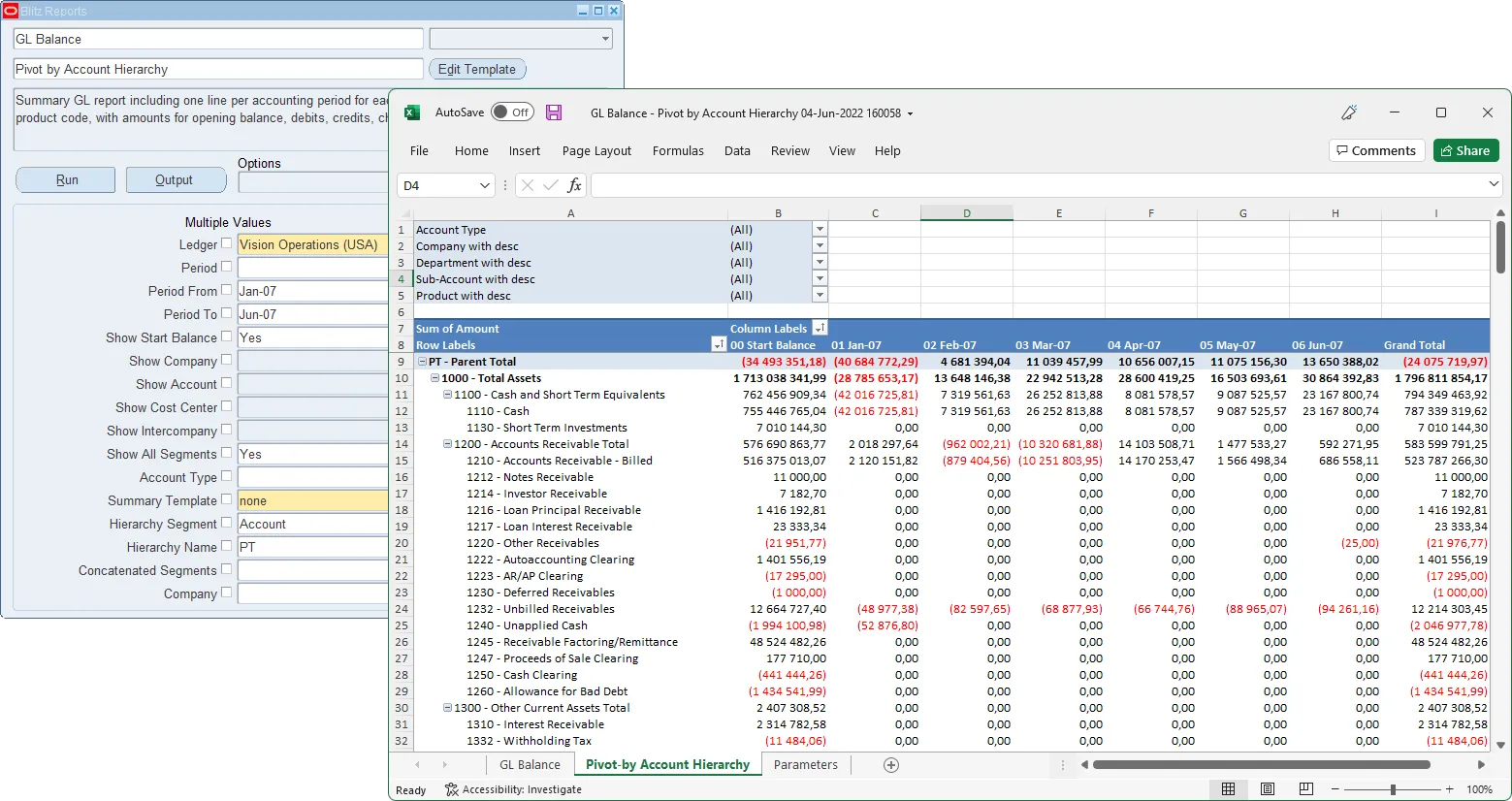
The Filters, Columns, Rows and Values fields are used to create and deliver the data in pivot table format with full drill down to details.
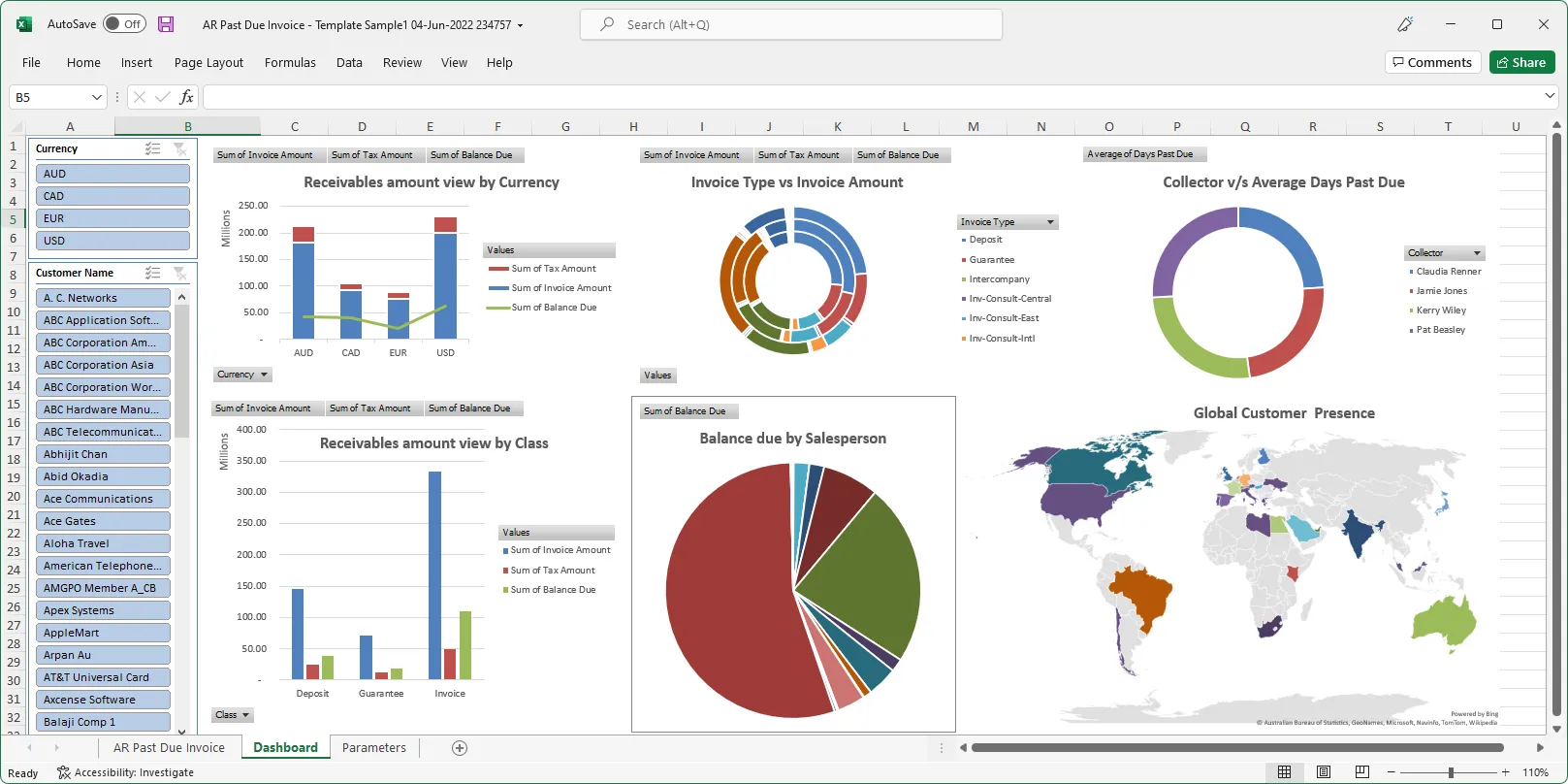
The Excel template upload functionality in Blitz Report allows users to create their own layouts by uploading an Excel template with additional sheets and charts, automatically refreshed when the report runs again. This allows to create custom dashboards and more advanced visualizations of report data.
You can download and use Blitz Report free of charge for your first 30 reports.
The installation and implementation process usually takes less than 1 hour; you can refer to our installation and user guides for specific details.
If you would like to optimize your Oracle EBS implementation and or operational reporting you can visit www.enginatics.com to review great ideas and example usage in blog. Or why not try for yourself in our demo environment.
Useful Links
Blitz Report™ – World’s fastest data upload and reporting for Oracle EBS
Oracle Discoverer replacement – importing worksheets into Blitz Report™
Blitz Report™ Questions & Answers
Supply Chain Hub by Blitz Report™
© 2025 Enginatics